Industry tips
How we cut an express tunnel's water use by more than half.
· 4 min read
Every car wash owner knows their chemical cost per car. Very few know their water cost per car.
Chemistry gets measured down to the milliliter, yet water only shows up once a month as a number on a bill, weeks after it was used, with no way to tell which day, which package or which problem drove it. And you pay for every gallon twice: once when it comes in from the city, and again as sewer when it goes down the drain.
You can't manage what you don't know. This summer we set out to change that at one of the express tunnels we serve. We measured it, ran our Water Playbook on it, and saw immediate results.
What unmeasured water costs
Across the express tunnels we track, fresh water use runs anywhere from 29 to 68 gallons per car, mostly on similar equipment. The average is 41 gallons per car.
The bigger cost is the problem nobody sees. At one tunnel we track, a single two-week stretch jumped to 99.5 gallons per car, more than double its normal. That's roughly 220,000 extra gallons in two weeks. Whatever caused it ran until the next meter reading caught it. Without that reading, the only sign would have been a bigger bill a month later, with no way to tell why.
Leaks, stuck valves, worn nozzles and equipment that quietly stops working don't announce themselves. They just keep running, and you keep paying, twice.
What measuring it saved one tunnel
This summer we started tracking one of the express tunnels we serve. Its water meter was read at every service visit and matched to its car count, so every number shown is per car.
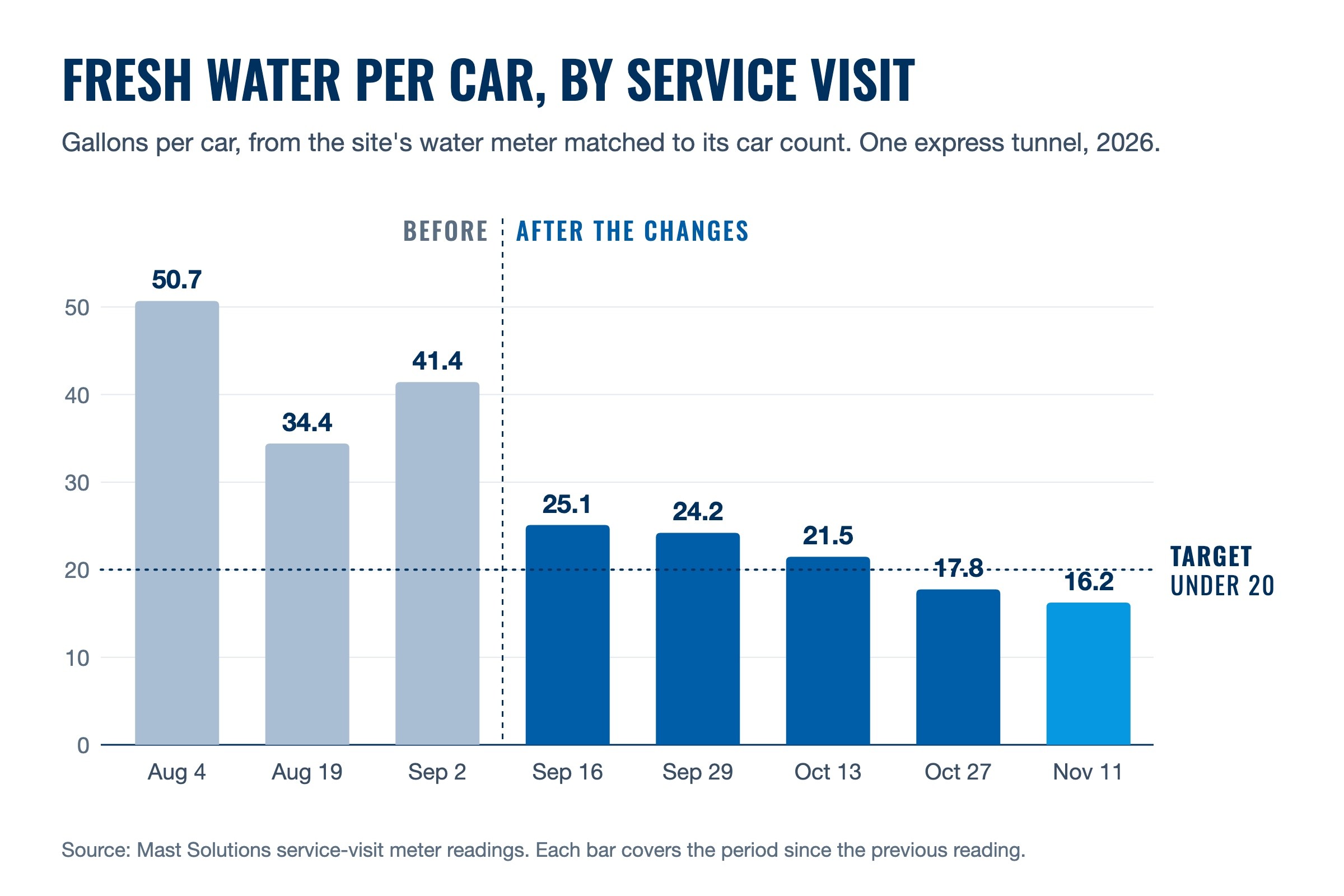
The first three readings came in at 50.7, 34.4 and 41.4 gallons per car. All together, the tunnel used 207,595 gallons to wash 5,094 cars: about 41 gallons on every car.
Once we could see where the water was going, our team went to work, implementing our Water Playbook. The next reading dropped to 25.1. The last two came in at 17.8 and 16.2 gallons per car, both under our target of 20. That's close to a 60% cut, and the wash quality got better, not worse.
In the ten weeks after the work started, the site washed 12,137 cars on 247,164 gallons of fresh water. At its old rate, those same cars would have used about 495,000. That's roughly a quarter million gallons saved in ten weeks, and the site is on pace to save about 1.3 million gallons a year.
At typical water and sewer rates in the area, about 1.75 cents a gallon, water cost per car went from about 71 cents to 28. For this one tunnel, that's about $23,000 a year. Across a 10-site chain, the same result would be worth more than $200,000 a year. This is money currently just going down the drain, literally.
Measured, not guessed
None of that savings happens without measurement. That's why every site in our water program runs on Mpulse, the platform we use to hold each site to its water and chemical targets.
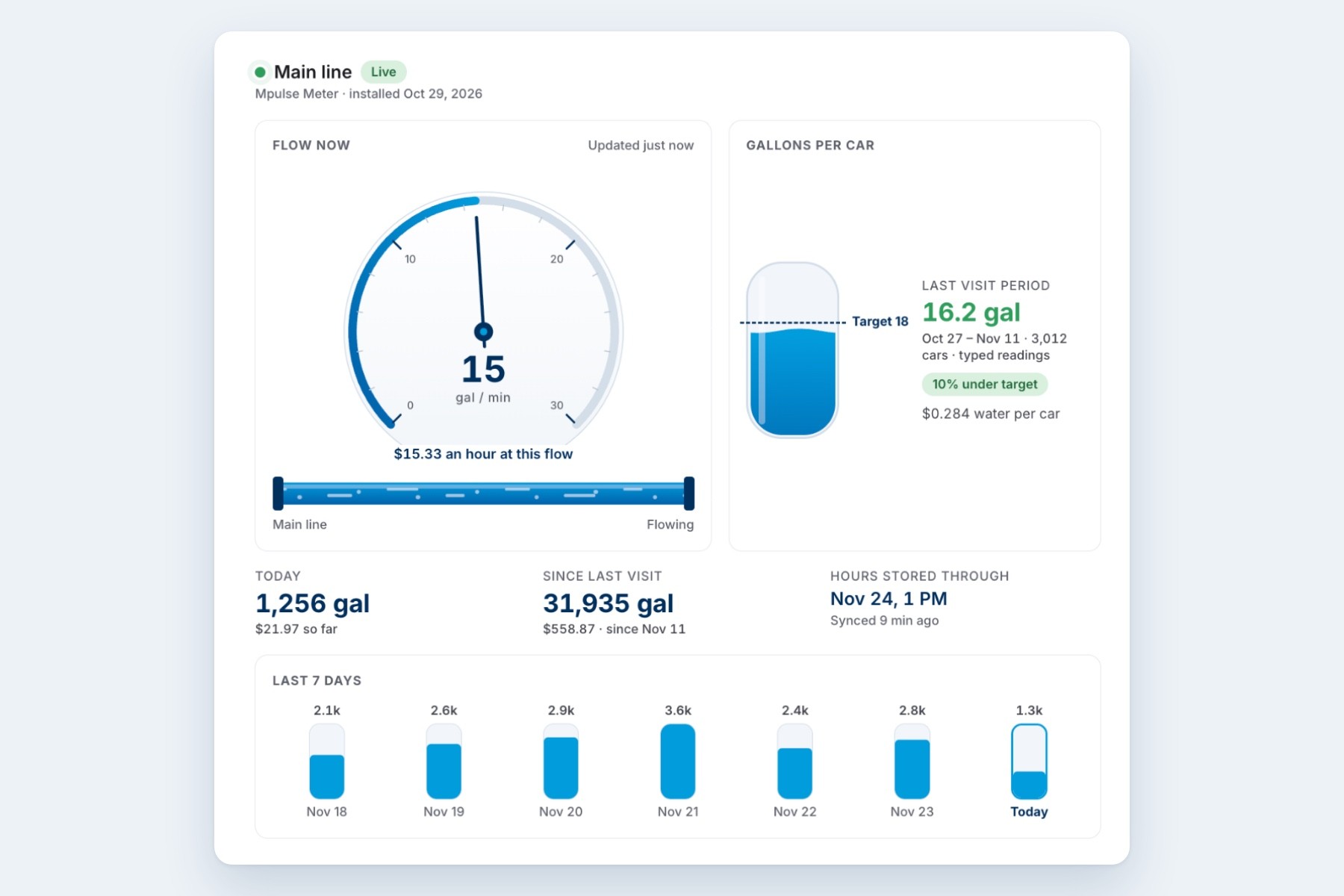
With an Mpulse Meter on the water line, you're not waiting two weeks for a reading or a month for a bill. You see:
- Flow right now, and what it's costing you by the hour.
- Gallons per car for every visit period, measured against the target set.
- Today and the last seven days, so a bad day stands out the day it happens.
- Water cost per car right next to your chemical cost per car.
When a site drifts over target, it gets flagged and our team fixes it, before it turns into a big bill. The screen above is from that same tunnel, now under its target.
Let's measure your tunnel
Every water program we run starts with three numbers: how much water you use per car, what a gallon costs you in water and sewer, and what you should be using. Most operators only know the second one, and only once the bill shows up.
If you'd like to know what your tunnel is really using per car, and what it could be saving, reach out to your Territory Manager or contact our team at sales@mastsolutionsinc.com to schedule a site visit.